


RENAL MITOCHONDRIAL MEDICINE
The Kidney Can Repair Itself.
We Give It the Signal.
MARY1 is a small molecule that targets a novel receptor to re-engage the kidney's own mitochondrial repair program — both preventing and accelerating recovery from acute injury, and interrupting progression to chronic disease.
The first selective 5HTR2B antagonist designed for renal mitochondrial repair — with a confirmed causal mechanism, a prespecified pharmacodynamic bridge from preclinical science to human proof, and a clinical strategy built for the setting most likely to produce a clean, attributable signal.

25–40%
of cardiac surgery patients develop AKI — our first proving ground for recovery biology in humans
AKI → CKD
acute injury that doesn't fully resolve drives nephron loss and CKD progression — a trajectory MARY1 is designed to interrupt
$38K
incremental cost per episode in dialysis, ICU, and readmissions — now accountable to hospitals under CMS TEAM
📄 Peer-reviewed science
Two published papers in renal recovery & mitochondrial pharmacology
🏛️ Exclusive worldwide license
Composition of matter & method of use · Sublicensing enabled

🔒 Protected IP
Issued US patents · Published PCT · Base term to 2044
📍IND-enabling stage
Seed / Series A financing · Actively engaged
What Makes MARY1 Different
🔄
Recovery and prevention biology
MARY1 targets the mitochondrial repair machinery that both prevents and reverses injury — with preclinical data supporting activity both before and after injury occurs. A therapeutic thesis built on activating recovery, not blocking a single injury signal.
🔬
A causal, confirmed mechanism
5HTR2B antagonism re-engages PGC-1α–linked mitochondrial repair. Knockdown and pathway inhibition confirm this is causal — not correlative. Validated in human proximal tubule cells.
📊
A measurable PD bridge
A panel of repair biomarkers — validated preclinically, being qualified as clinical assays — will confirm at every human dose that the drug is engaging the target in the kidney.
PATIENTS & CLINICIANS
An active recovery tool, not more waiting
MARY1 is designed to give clinicians a pharmacological tool to drive tubular repair, reduce dialysis dependence, shorten ICU stays, and protect long-term kidney function — in patients who currently have no disease-modifying option.

PAYERS & HEALTH SYSTEMS
Recovery economics, directly measurable
Under CMS TEAM (January 2026), ~741 hospitals are accountable for 30-day CABG episode costs. The clinical endpoints are designed to map directly to the economic case, with HEOR prewired from day one.
INVESTORS
Decision-grade data at every gate
Each development stage is designed to produce the evidence standard needed for the next financing event. Preclinical mechanism is confirmed. Exposure, PD, and recovery trajectory are the defined targets of the clinical program.
STRATEGIC PARTNERSHIPS
A renal platform with earned expansion
Preclinical evidence spans CSA-AKI, kidney transplant, diabetic kidney disease, and aging kidney. The CSA-AKI wedge is the capital-efficient entry. Expansion into a broader renal franchise is earned — not assumed — through clinical data.
If kidney recovery has been on your list of unsolved problems, we'd welcome the conversation.
We're actively engaged with investors and strategic partners who understand the AKI field — its history, its potential, and what it takes to succeed where others haven't.
Veena Krishnappa - drveenagowda@gmail.com - +1 (561) 371 5512
⚡ Both preventive and reparative activity
Preclinical studies support MARY1 activity in two distinct windows: administered prior to anticipated ischemia-reperfusion injury, MARY1 reduces the severity of renal injury; administered after injury, it drives recovery. Additional IP covering the preventive use is in process.
🔬 Validated across species and models
Reproducible signals in mouse and rat ischemia-reperfusion AKI, diabetic kidney disease, and aging kidney models. 5HTR2B expression and MARY1 activity confirmed in rabbit, mouse, and human proximal tubule cells.
📊 A measurable PD bridge to humans
PGC-1α, mitochondrial DNA, FAO and ETC proteins, and tubular injury signals are being developed as qualified clinical assays — designed to confirm mechanism engagement and recovery attribution in first-in-human studies.
🛡️ Class-aware safety logic
Known 5HTR2B valvulopathy risk is agonism-linked. MARY1 is a functional antagonist with no 5HTR2A/2C activity at tested concentrations. Rat 28-day tolerability preserved survival, body weight, and organ weight to 100× the therapeutic dose.
THE SCIENCE
Mitochondrial repair is the
unaddressed mechanism in AKI
Ischemia-reperfusion injury drives mitochondrial dysfunction — loss of membrane potential, failure of ATP synthesis, and tubular cell death. Most programs target inflammation downstream. MARY1 targets the upstream reset switch.
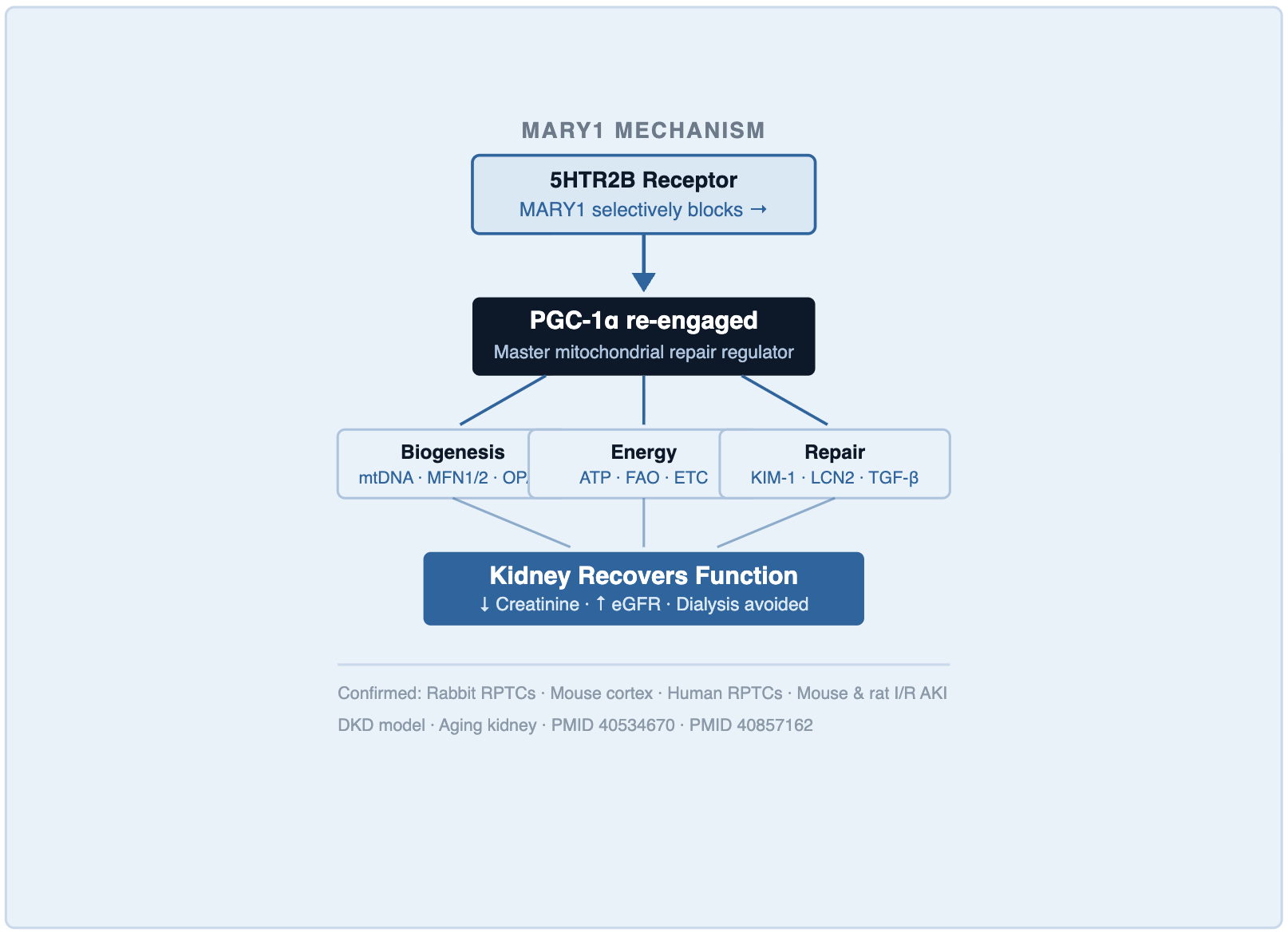
MARY1 selectively blocks 5HTR2B, freeing the PGC-1α repair cascade to re-engage — restoring mitochondrial biogenesis, fatty acid oxidation, and electron transport chain function in proximal tubule cells. The same mechanism that prevents injury from occurring also drives recovery after it does.
Published preclinical evidence
Two peer-reviewed papers establish the mechanistic and in vivo basis for MARY1's clinical development.